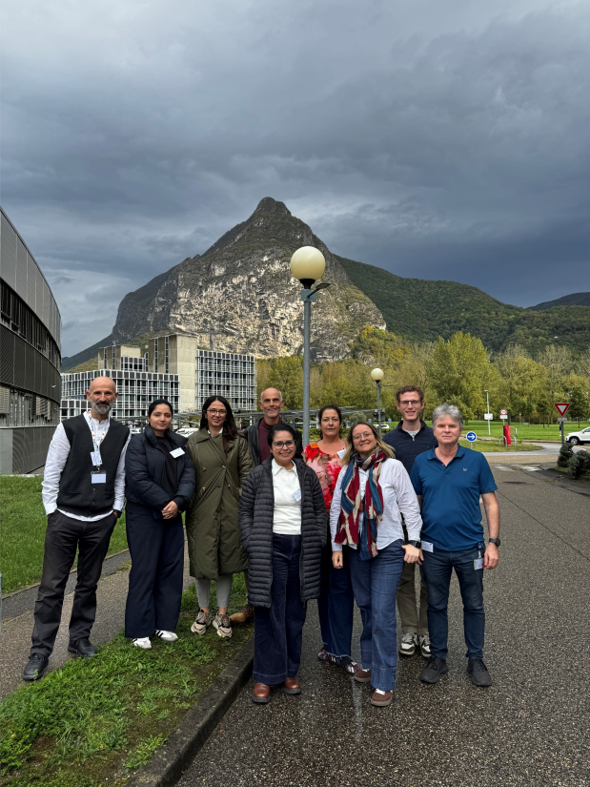
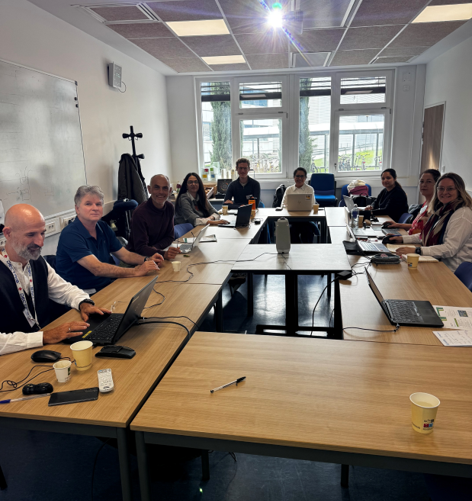
Photo; Members of X-SeeO2 Consortium at ESRF From left clockwise: Miguel Aranda (UMA) Tayyaba Rabnawaz (UoM – ESRF) Ilda Tole (UoB) Phil Withers (UoM) Lisa Huckfield (UMA) John Morely (UoB) Andy Fitch (ESRF) Angeles G. De la Torre (UMA) Susan Bernal (UoB)
How does carbon dioxide react with cement-based materials, and how do their microstructures evolve throughout the process?
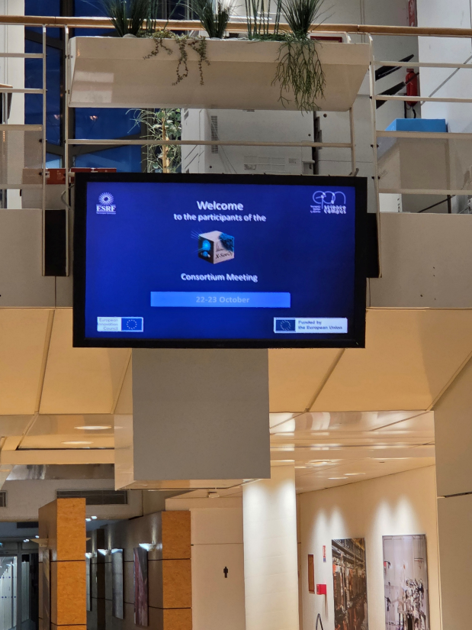
This critical question brought together the European Innovation Council (EIC) Pathfinder Challenge consortium, X-SeeO2 for its Second Annual General Meeting on October 22–23, 2026.
Hosted by the European Synchrotron Radiation Facility (ESRF) in Grenoble, France, the two-day event gathered researchers and partners from the University of Malaga, the University of Bath, the University of Manchester, and the ESRF to share pivotal progress in tracking CO2 mineralisation as it happens using state-of-the-art X-ray technology.

Pushing the Boundaries of In-Situ Characterisation
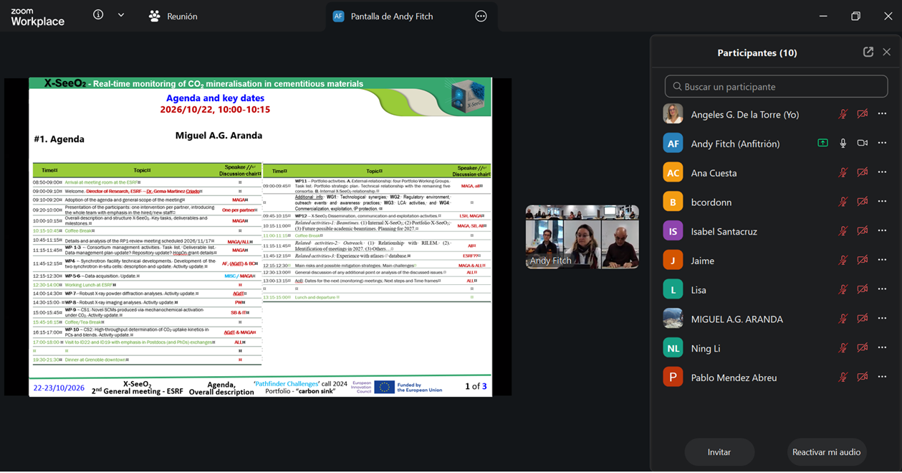
During the meeting, the consortium, joined online by colleagues, reviewed the significant strides made across multiple work packages aimed at capturing mineral carbonation at a microscopic level:
X-Ray Powder Diffraction (XRPD): Early results from the commissioning of the pressurised capillary in-situ cell have proven exceptionally promising. Commissioning is ongoing with the primary goal of tracking how crystalline phases evolve during CO2 mineralisation, including evaluating the physical effects of varying reaction cell sizes (capillaries).
X-Ray Imaging: Development of a dedicated pressurised in-situ cell for X-ray imaging is well underway. This tool will allow researchers to visualise directly how the internal microstructures of cement-based materials transform during mineral carbonation.
Methodology and Data Harmonisation: Partners dedicated significant time to discussing how to enhance the robustness and cross-laboratory comparability of measurements—ranging from standardised sample preparation to advanced data analysis. The team also reviewed progress on experiments quantifying the CO2 uptake rates of different cement binders under pressurized and accelerated curing conditions.
How we see the CO2
There was even time to visit the experimental set-up at ESRF ID19 and ID22 beamlines and see the specially-designed pressurised capillary in-situ cell.
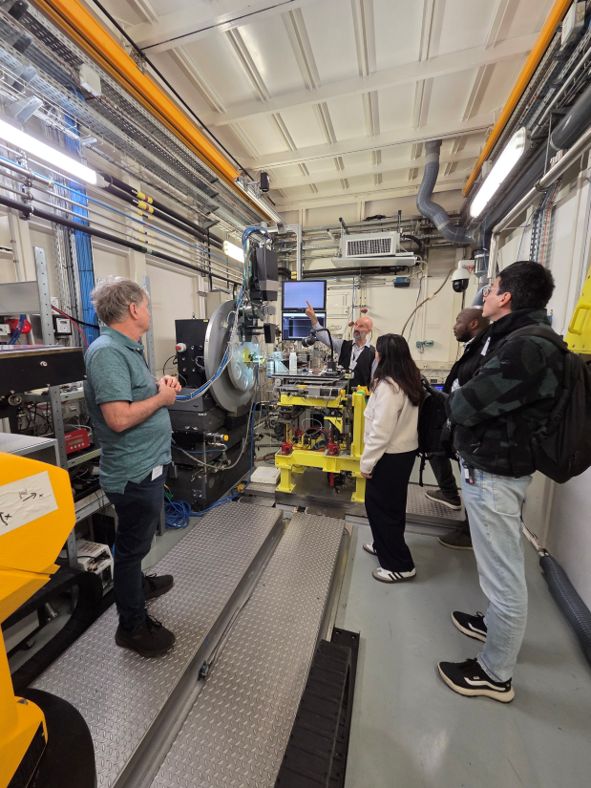
beamlines and see the specially-designed pressurised capillary in-situ cell.
Collaborative Science for a Sustainable Future
The success of the annual meeting highlights the power of interdisciplinary collaboration in tackling climate challenges and lowering the carbon footprint of the construction sector.
We extend our sincere thanks to Andy Fitch and the entire ESRF team for graciously hosting this year’s meeting, to project coordinator Miguel Aranda for his leadership, and to all participating partners for two days of deeply engaging discussions, shared insights, and collaborative momentum.
Stay tuned for more updates as the X-SeeO2 project continues to pioneer.